


Purpose. Power. Process.
The Learner Development Index© (LDI)
The Learner Development Index is the delivery component of the SBM system. Where the SBM and ISF govern design, and the PSMP governs assessment, the LDI governs what happens between them: the observable, measurable development of the learner across the full arc of a learning program.
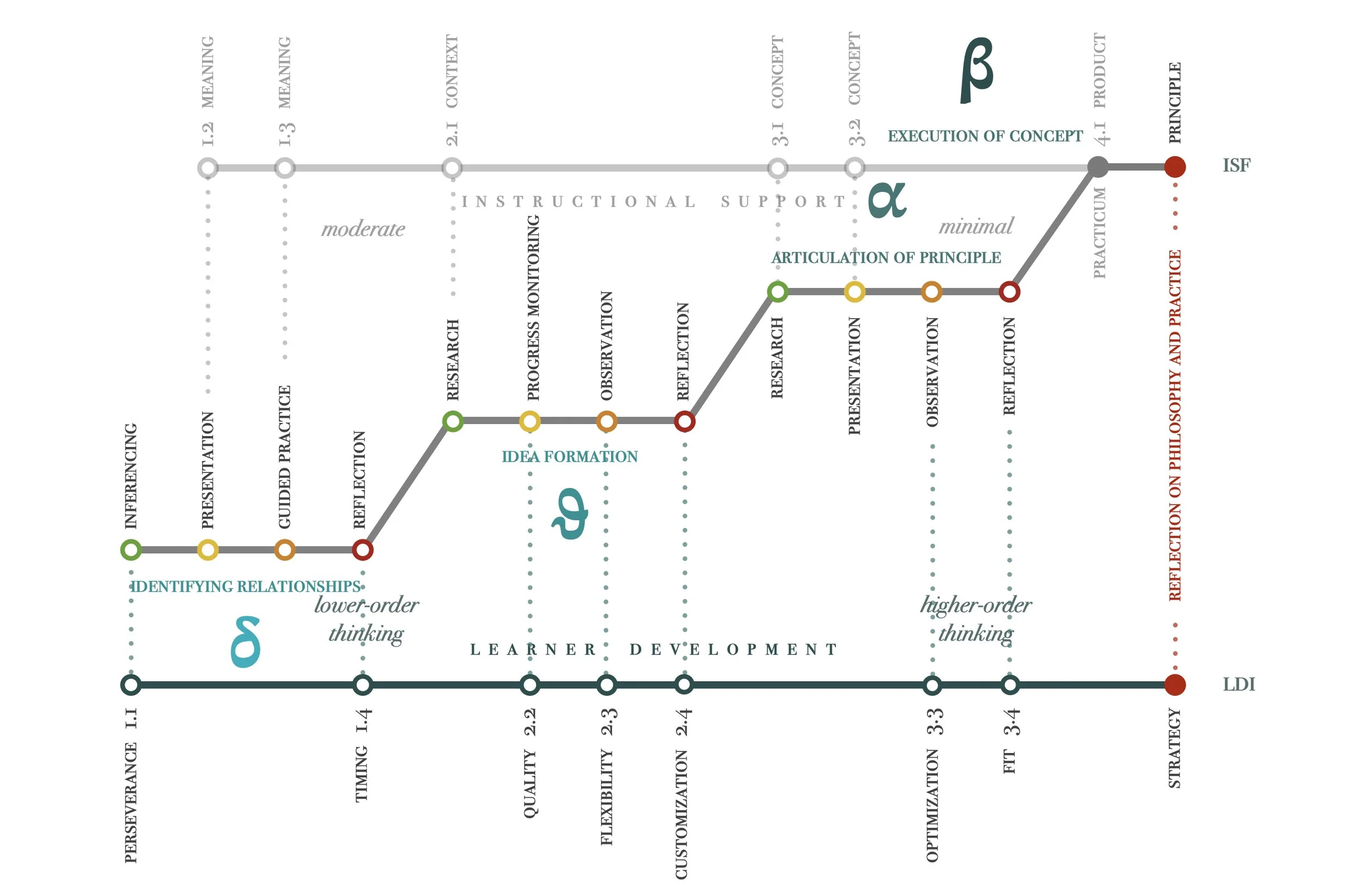
Most evaluation frameworks measure outcomes after training concludes. The LDI measures development as it occurs — providing the instructor or facilitator with a structured observation methodology that tracks progress at seven intervals across three developmental dimensions.
-
The LDI organizes learner development around seven performance markers, each assessed at a designated interval within the learning program:
Perseverance measures a learner's ability to navigate the foundational skills and habits of a program through repetition — specifically identifying what impedes completion at the earliest stages of development.
Timing examines where learners are spending the most time within a process, and why — using that data to refine instructional pacing and resolve bottlenecks before they compound.
Quality assesses adherence to the standards and benchmarks prescribed for a skill or task, examining how learners are applying new approaches and whether the work produced corresponds with established criteria.
Flexibility measures a learner's ability to apply foundational skills across a diverse range of contexts, settings, and conditions — moving from narrow application toward adaptive, transferable performance.
Customization examines how learners independently develop a focus within a designated area of study, measuring the depth and originality of their contribution to the collective body of work.
Optimization tracks how learners incorporate feedback — from peers, facilitators, and their own self-assessment — into the revision and expansion of their work over time.
Fit provides a cumulative assessment of whether the learner's final body of work satisfies the program's performance prerequisites, evaluating coherence, accountability, and the degree to which the learner's development serves both individual and collective objectives.
-
The seven markers are organized across three dimensions of delivery: Purpose (markers 1.1 and 1.4), which addresses the initial reinforcement of foundational skills; Power (markers 2.2, 2.3, 2.4), which addresses the application and expansion of those skills across contexts; and Process (markers 3.3 and 3.4), which addresses the synthesis and evaluation of work in its most complex and self-directed form.
Together, these dimensions mirror the cognitive progression built into the SBM's Module Design Sequence — lower-order thinking with high instructional support in the early phases, progressing toward higher-order thinking with minimal instructional support by the final phase.
-
The LDI gives instructors and program designers something most evaluation frameworks don't: actionable data during delivery rather than after it. By the time an end-of-program assessment reveals a performance gap, it is often too late to address the conditions that produced it. The LDI surfaces those conditions at the intervals where intervention is still possible — making it a formative measurement tool as much as a summative one.
Where Framework Meets Field.
The LDI is designed for environments where extended programs require ongoing progress monitoring during delivery — academic programs, technical and vocational training, and structured professional development contexts where performance gaps need to be identified and addressed before they compound.