


Meaning. Context. Concept. Product.
The Instructional Support Frame® (ISF)
The Instructional Support Frame is the contextualization layer of the SBM system. Where the SBM provides the architectural structure of a learning program, the ISF determines how the content within that structure is made accessible to its specific audience.
Every learner arrives with a frame of reference — a body of prior knowledge, professional experience, and contextual familiarity that either supports or impedes their ability to make meaning from new content. When instructional content lacks sufficient correspondence with that frame of reference, learners can recognize information on the surface — pass multiple-choice assessments, recall terminology — without developing the functional understanding needed to apply it. The ISF is designed to bridge that gap.
-
An ISF is a contextualized representation of a subject in which elements familiar to the target audience are used to construct meaning equivalences for content that would otherwise be inaccessible. It does not simplify content — it creates a pathway into it. The distinction matters: an ISF does not lower the standard; it builds the contextual bridge that allows a broader range of learners to reach it.
This contextualization operates through four media, each representing a distinct mode of engagement with content:
Visual — Diagrams, models, and scaffolded representations that allow learners to interpret a subject's structure and relationships before engaging with its technical complexity.
Auditory — Translation of specialized or domain-specific language into terminology and analogies drawn from the learner's existing professional or experiential context, with deliberate pacing and repetition to support retention.
Kinesthetic — Simulated or applied experiences that place the learner in contexts requiring them to use the subject — not just observe it — so that the underlying principle is discovered through doing rather than told through instruction.
Written — Annotated models and scaffolded texts that make explicit the relationships between elements of a subject, guiding the learner's interpretation rather than assuming it.
-
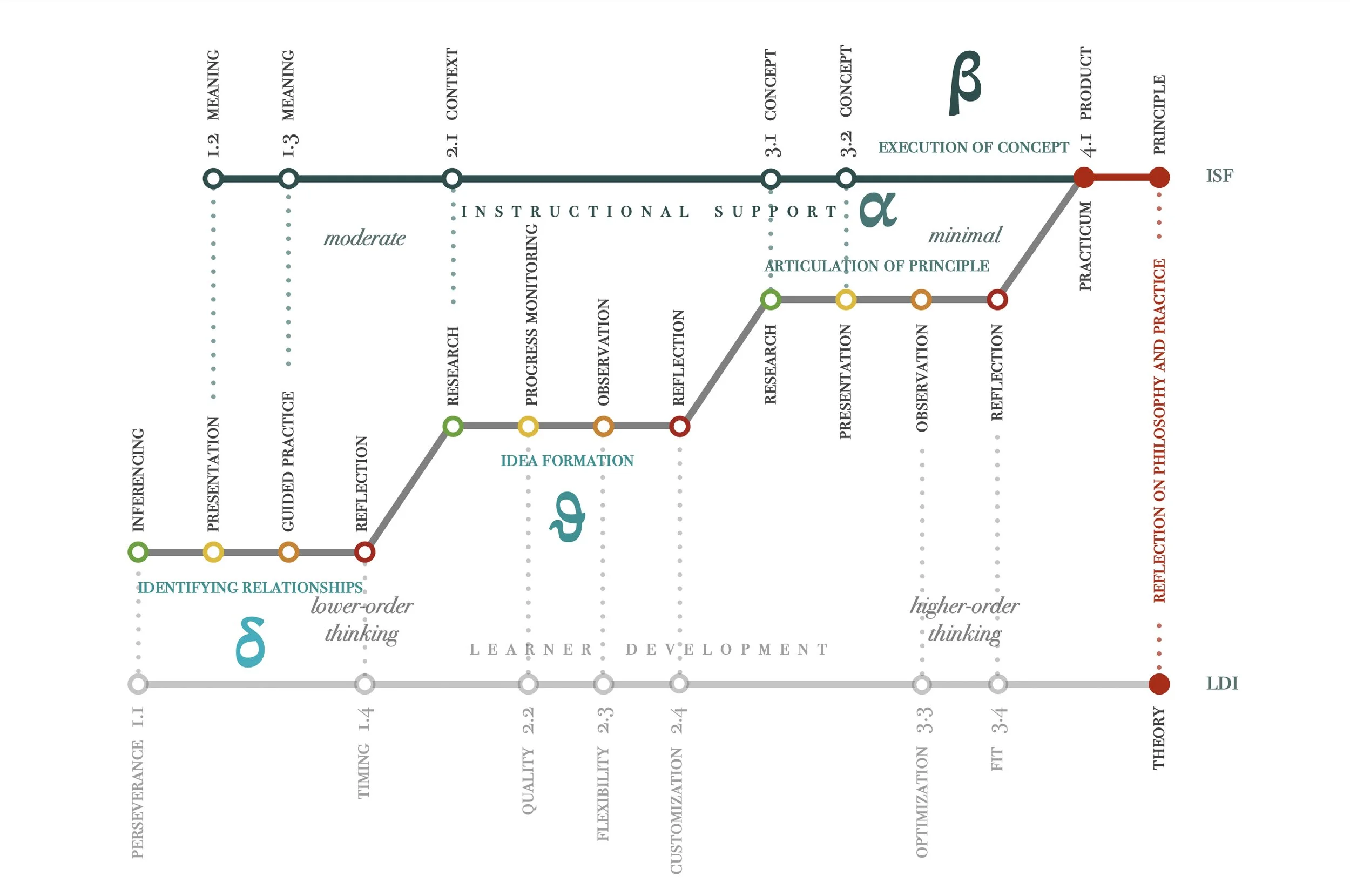
The ISF corresponds directly with the SBM's Module Design Sequence at the meaning, context, and concept stages of development (Modules 1.2, 1.3, 2.1, 3.1, 3.2). Its design is informed by LDI scores — the observed developmental data gathered during delivery — which indicate where a given learner population is in its progress and what kind of contextual scaffolding the next learning event requires.
The practical effect: an ISF allows the same instructional content to be delivered effectively across audiences with meaningfully different experiential baselines — across departments, roles, industries, experience levels, and organizational cultures — without redesigning the program from scratch for each audience.
Where Framework Meets Field.
The ISF is designed for environments where learner populations bring meaningfully different experiential baselines — academic programs, vocational training, and cross-functional or new hire cohorts where content must be made accessible without being simplified.