


The Rubric That Diagnoses.
The Point System Measurement of Proficiency© (PSMP)
The Point System Measurement of Proficiency is the base rubric of the SBM system — the instrument through which all performance outcomes, across all frameworks, are evaluated and communicated.
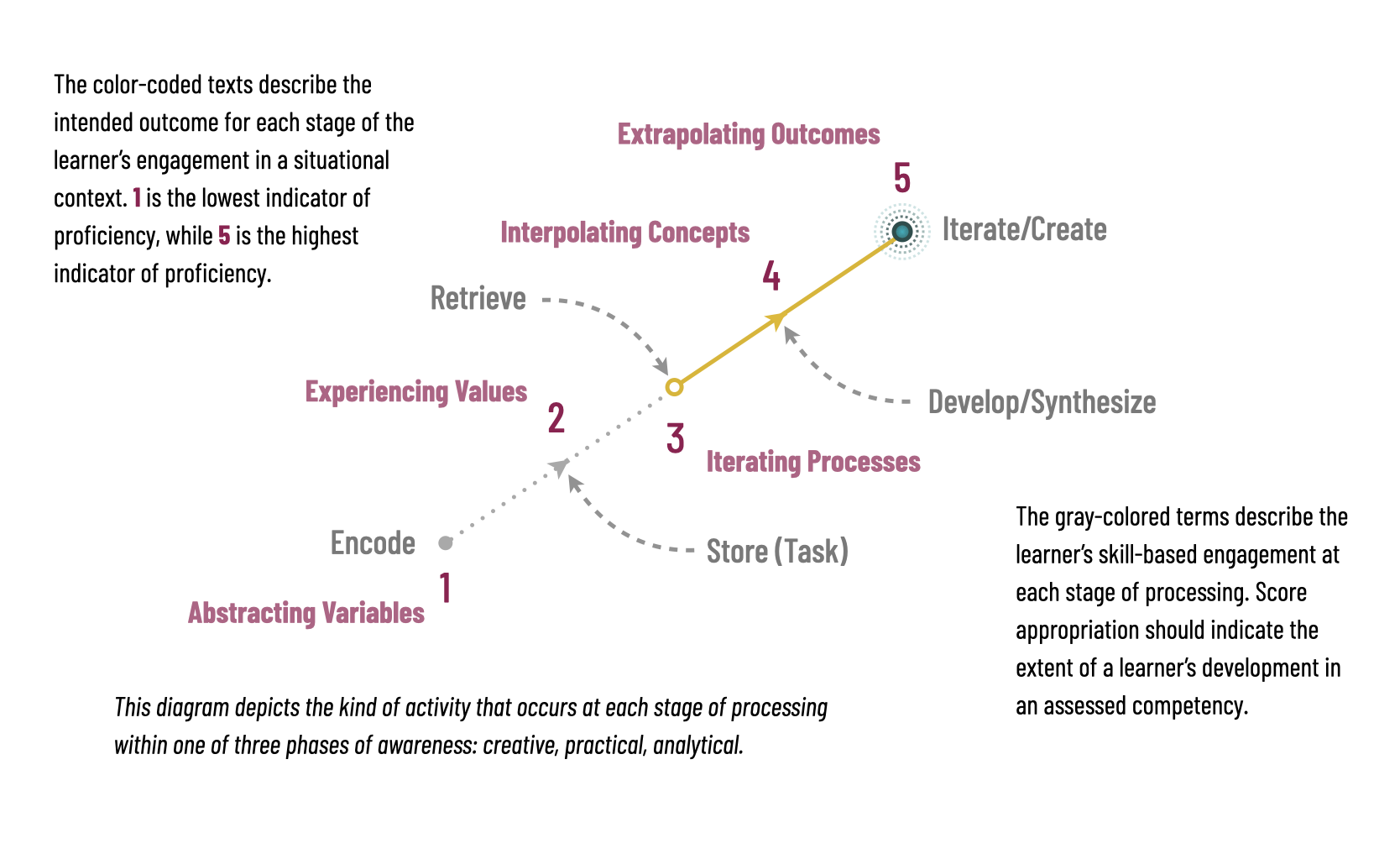
Most assessment rubrics produce a score. The PSMP produces a stage. Each point value corresponds not to a percentage of correct answers but to a specific, observable stage of development — making the score itself a diagnostic tool that tells the instructor not just how well a learner performed, but where in the development process they currently are and what kind of support or next step is warranted.
-
The PSMP operates across two assessment tracks, corresponding with two types of learning evidence:
Reading and Reception (A/D) — a three-point scale used to evaluate comprehension-based performance: discussions, presentations, and in-class assessments. The three points correspond with a learner's ability to decode a subject (1), retain its meaning through media (2), and retrieve and apply the underlying concept in assessment contexts (3).
Performance and Writing (B/C) — a five-point scale used to evaluate application-based performance: research projects, extended written assignments, and kinesthetic demonstrations. The five points move from significant difficulty communicating foundational understanding (1) through developing coherence (2), sufficient command with notable gaps (3), structurally sound integration with minor discrepancies (4), and full mastery — where empirical rigor and adherence to technique define every stage of execution (5).
-
The PSMP's most significant advantage is the interpretative clarity it provides — both to the instructor assessing the work and to the learner receiving the assessment. When a score is tied to a stage of development rather than a raw percentage, the feedback it generates is inherently actionable: not "you scored a 68%," but "you are at the approaching stage, which means you can communicate coherent understanding of the subject but are not yet integrating its principles with sufficient precision for independent application." Each stage maps directly to a prescribed next step — additional scaffolding, targeted practice, or advancement — eliminating the interpretive gap between what a score means and what should happen in response to it.
The PSMP also resolves one of the most persistent problems in performance-based assessment: interpretive inconsistency between evaluators. Because each point value is anchored to observable, behavioral descriptors — not impressionistic qualitative judgments — different evaluators applying the PSMP to the same body of work are more likely to arrive at the same score for the same reasons.
Where Framework Meets Field.
The PSMP is designed for environments where learning itself is the primary objective — academic programs, vocational training, and structured skill development contexts where performance stages can be observed, documented, and acted on.