


Clarity. Precision. Patience. Discipline.
The Standard Block Method© (SBM)
Most training programs are built around a flawed premise: that retaining information is sufficient evidence of readiness to perform. Passing an assessment on the basis of recognition — selecting answers that resemble recalled words or phrases — is not the same as knowing. Knowing is a lived experience. The Standard Block Method was developed to close that gap.
The SBM is a comprehensive instructional design philosophy and architecture that provides learning professionals with the structural tools to simulate lived experience — creating the conditions under which a learner doesn't just encounter content, but develops a functional, applicable understanding of it. It operates on the principle that how content is sequenced and delivered is as consequential as the content itself.
-
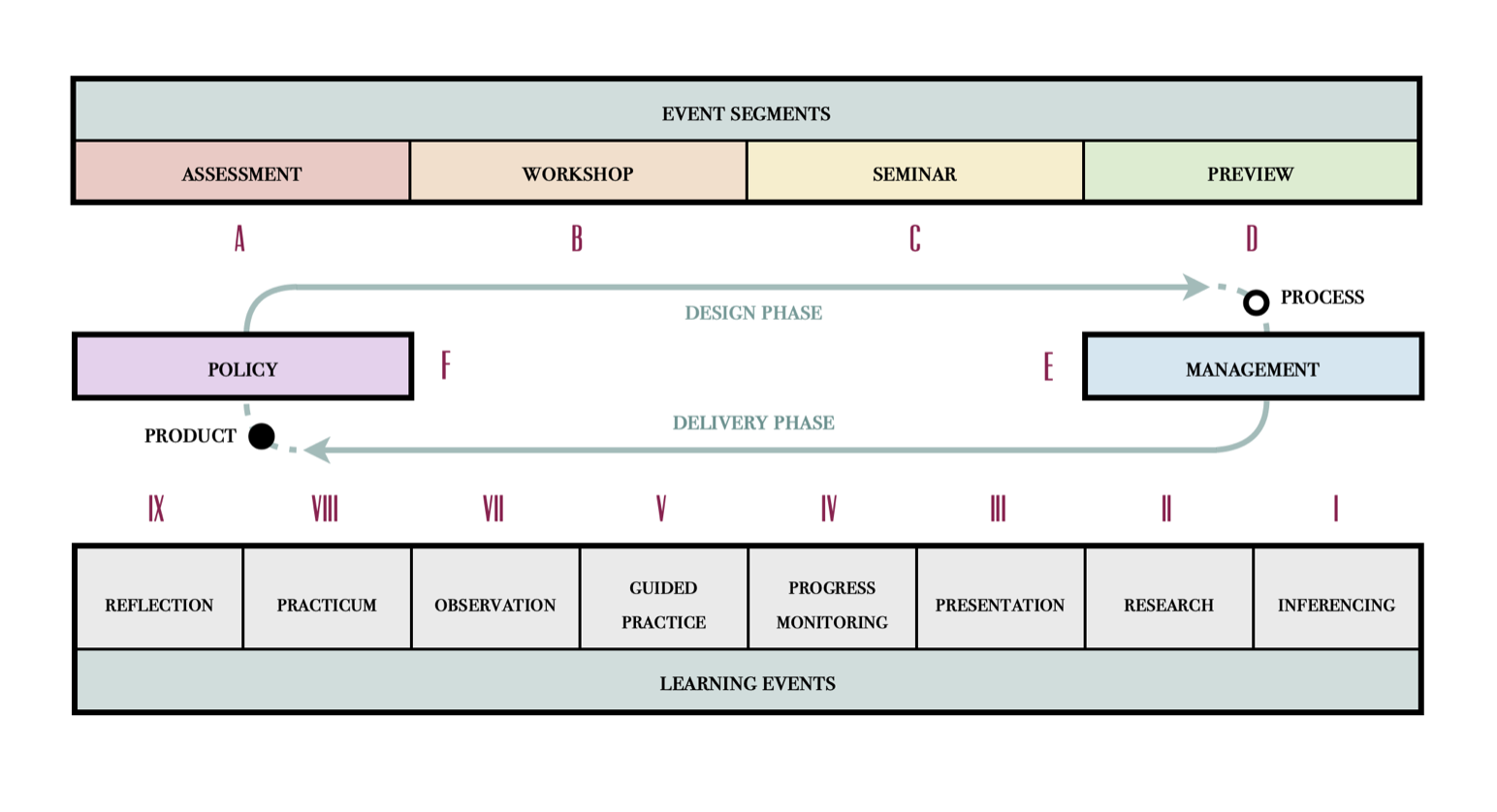
The SBM is organized into two phases: a design phase and a delivery phase.
The design phase begins with Policy — the institutional standards, compliance requirements, and performance expectations that govern what the program must produce. From Policy, the designer works backward through four design layers: Assessment, Workshop, Seminar, and Preview/Review. The Performance-Based Metric System (PBMS) anchors each of these layers, establishing a hierarchy of learning objectives that progress from Enabling Objectives in the Seminar layer, to Terminal Objectives in the Workshop layer, to the Course Goal established at the Assessment layer. This backwards design approach ensures that every instructional decision — every activity, every piece of content, every facilitated discussion — is traceable to a specific, documented performance benchmark.
The delivery phase is governed by Management — the facilitation guidelines, procedural standards, and instructional support structures that determine how the designed program reaches the learner. Management functions as a conduit between what was designed and what is delivered, ensuring that variables inside and outside the learning environment do not compromise the program's effectiveness.
-
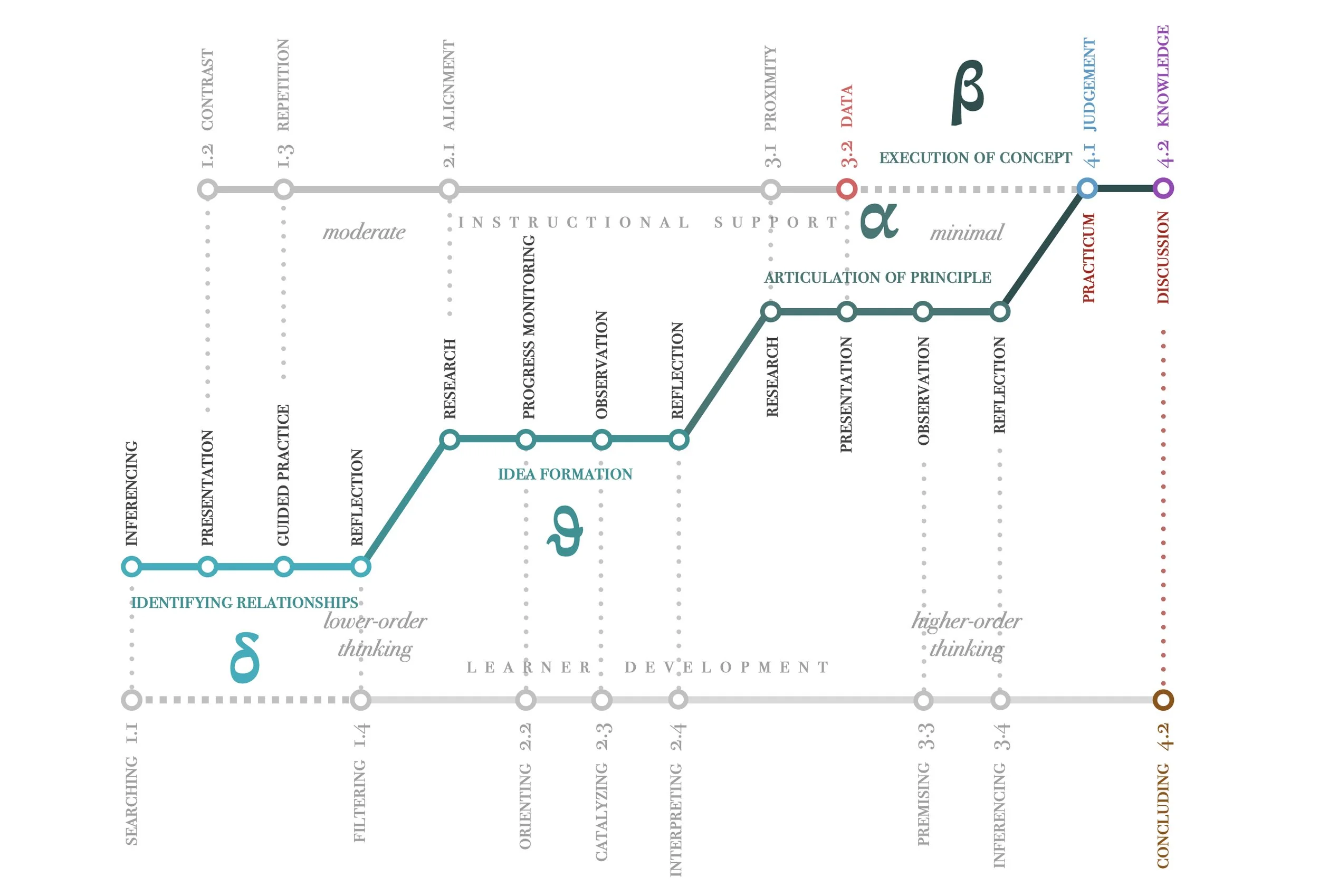
Within the delivery phase, nine Learning Events provide the specific instructional formats through which learners engage with content: Inferencing, Research, Presentation, Progress Monitoring, Guided Practice, Observation, Practicum, and Reflection. These are sequenced through four Module Design Sequences (𝛅, 𝛝, 𝛂, 𝛃) that move the learner progressively from initial concept formation and guided development to self-directed application and demonstrated competency.
Each sequence builds deliberately on the last. Early sequences carry the highest instructional support and focus on lower-order thinking: recognizing, understanding, and making initial meaning from content. Later sequences reduce instructional support as the learner applies, analyzes, and ultimately synthesizes knowledge independently. By the final sequence, the learner demonstrates competency through self-directed performance — not through recognition of what was presented, but through application of what was internalized.
-
ADDIE and SAM address the overarching instructional design process — from analysis through evaluation. They do not prescribe how a course is internally structured, leaving that to the judgment of the individual designer. Gagné's Nine Events of Instruction is the closest comparable framework in intent and can be used in tandem with the SBM — Gagné providing precision at the individual event level, the SBM providing the broader structural architecture within which those events are organized and sequenced. The SBM is not an evaluative framework; Kirkpatrick and similar models operate at a different level and are complementary, not competitive.
The SBM's defining advantage is its accessibility across learner populations with differing levels of prior knowledge and contextual familiarity. By not assuming that every learner arrives with the same experiential baseline — whether that difference is rooted in professional background, industry experience, technical expertise, or organizational culture — the SBM creates learning conditions that reduce the cognitive burden of orientation and redirect that capacity toward comprehension and application. A system designed to serve the broadest range of learners serves all learners better.
-
The SBM is most impactful in large-scale learning programs: new hire onboarding, cross-functional technology rollouts, certification programs, and academic or vocational curricula where learners have no substantial prior background in the subject area. It scales from a single lesson to a full curriculum, but its structural benefits are most pronounced when the stakes of getting training right are highest.
In a Software Engineering and Systems Administration program, implementation of the SBM produced a 48% increase in passing rates, with the majority of previously struggling participants reporting significantly reduced cognitive load and improved comprehension under the restructured program.
A Component of the SBM
The Objective Hierarchy (PBMS)
Every event segment of the SBM is anchored by the Performance-Based Metric System — the objective hierarchy that turns learning objectives into required benchmarks of proficiency.
Most instructional designs treat learning objectives as a checklist: statements of what a course will cover, written once and rarely revisited. The PBMS treats them differently. Within the SBM, it is the starting point and anchor for every event segment — and it organizes those objectives into a deliberate hierarchy rather than a flat list.
That hierarchy moves in three tiers. Enabling Objectives, anchored in the Seminar segment, establish the foundational understanding a learner must build first. Terminal Objectives, anchored in the Workshop segment, define what the learner must be able to do once that foundation is in place. The Course Goal, anchored in the Assessment segment, expresses the culminating performance the entire program is designed to produce.
What distinguishes the PBMS is the weight those objectives carry. They are not aspirational statements of coverage — they are the required benchmarks of progress each learner must demonstrate to satisfy the program's completion requirements. A learner doesn't finish the program by completing its activities; they finish it by demonstrating proficiency against the benchmarks the PBMS defines. This is what makes the SBM's backward design enforceable: because every activity, every piece of content, and every facilitated discussion traces back to a documented benchmark, "done" becomes a question of demonstrated capability measured against a documented standard.
The Hierarchy, Anchored to the SBM
Each objective tier is anchored to an event segment. Design works downward from the Course Goal; the learner builds upward to meet it.
Where Framework Meets Field.
The SBM is designed for environments where a learning program requires rigorous, scalable structure — academic programs, technical and vocational training, and structured professional development contexts where sequencing, scaffolding, and assessment need to be traceable to a defined performance need.